
The 8 Phases of EMDR Therapy: What Happens at Each Stage?

Some experiences do not fade with time. A memory from years ago can still bring up the same fear, shame, or tension it did when it happened, even when you know logically that it is over.
EMDR therapy is designed to change that, and it does so through a structured, eight-phase process. Each phase has a specific purpose, from preparing the nervous system for difficult material to confirming that progress holds between sessions. This article explains what happens at each stage, why the structure matters, and what to expect in treatment.
What Is EMDR Therapy?
Eye Movement Desensitization and Reprocessing (EMDR) is an evidence-based therapy that helps the brain reprocess distressing memories. It was developed by psychologist Francine Shapiro in the late 1980s and was originally used to treat post-traumatic stress disorder (PTSD).
Today, EMDR is also used for anxiety, panic, grief, low self-worth, and distressing life events. Unlike traditional talk therapy, it focuses less on analyzing an experience and more on changing how that experience is stored. The memory remains, but its emotional charge fades.
What Is the Adaptive Information Processing Model?
The Adaptive Information Processing (AIP) model explains why some memories stay stuck and how EMDR helps them resolve.
According to this model, the brain has a natural system for processing experiences. After a difficult event, most people gradually make sense of it by talking it through, sleeping on it, and connecting it to what they already know. The event becomes a memory that can be recalled without being re-lived.
When an experience is too overwhelming, this system can stall. The memory is stored in its original, unprocessed form, with the images, emotions, beliefs, and body sensations from that moment still attached. Later, a reminder in the present can activate that stored material as if it were happening again.
This is why a conflict at work can bring up the same helplessness felt in childhood, or why a certain smell can trigger sudden dread. The present-day reaction is often driven by past experiences that were never fully processed. The eight phases of EMDR provide a structured way to access that material safely and help the brain finish the job.
The 8 Phases of EMDR at a Glance
The EMDR International Association (EMDRIA) describes the eight phases as a map that guides treatment. Not every phase occurs in every session, but each one contributes to the overall result.
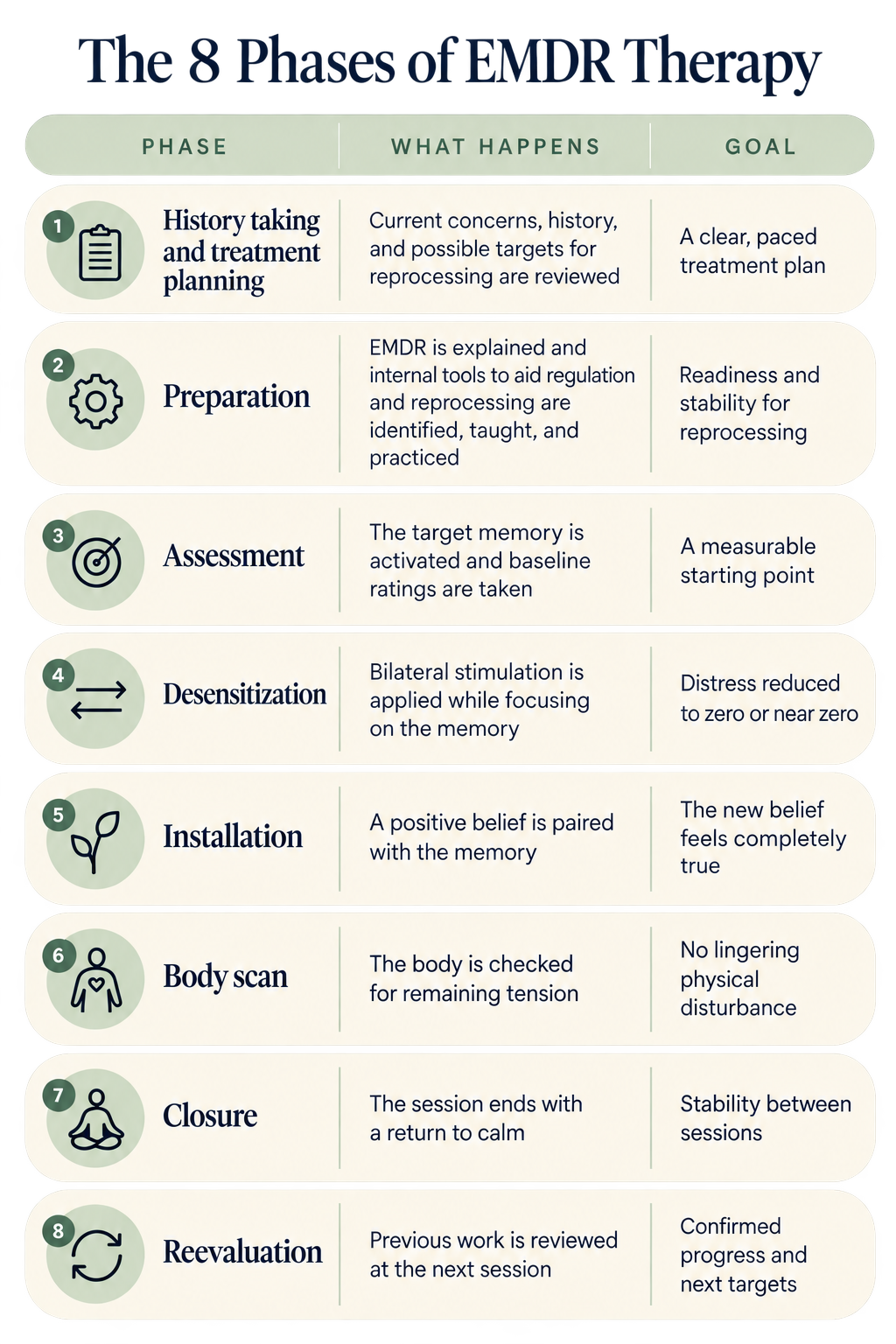
Phases 1 and 2 lay the groundwork. Phases 3 through 6 form the active reprocessing sequence. Phases 7 and 8 protect stability at the end of one session and the start of the next.
Phases 1 and 2: Preparing for Reprocessing
Phase 1: History Taking and Treatment Planning
EMDR begins with assessment. The therapist gathers information about current symptoms, relevant history, and goals for treatment, and a working relationship begins to form.
The main task of this phase is identifying targets for reprocessing. EMDR addresses three areas, known as the three prongs:
Past memories – earlier experiences that set the foundation for current difficulties
Present triggers – situations that bring up distress today
Future responses – situations the client wants to be able to handle differently
A detailed account of every painful memory is not required. A brief outline is usually enough to build a treatment plan and decide on pacing.
Phase 2: Preparation
Preparation supports the nervous system having enough stability to handle reprocessing. The therapist explains how EMDR works, what bilateral stimulation involves, and what may happen during and between sessions.
This phase also builds coping resources. Common tools include calming breathwork, a calm place visualization, and a container exercise for setting distressing material aside until the next session. A stop signal is agreed on in advance, so reprocessing can be paused at any time.
The length of this phase varies depending on various factors including current stability, what coping resources are already present, and the complexity of the trauma. Extended preparation is not a delay; it is what makes the later phases safe and effective.
Phases 3 Through 6: Reprocessing a Memory
Phases 3 through 6 are where a specific memory is reprocessed. Phases 4, 5, and 6 use bilateral stimulation (BLS), such as side-to-side eye movements, alternating taps, or tones. BLS activates the brain's processing system while keeping attention anchored in the present, a state known as dual attention.
Phase 3: Assessment
Assessment activates the target memory and establishes a baseline. The therapist asks the client to identify four elements:
Image – the picture that represents the worst part of the memory
Negative belief – what the memory seems to say about the self, such as "I'm not safe" or "It was my fault"
Positive belief – what the client would prefer to believe, such as "I'm safe now" or "I did the best I could"
Emotions and body sensations – what comes up when the memory is held in mind, and where it is felt
Two scales measure the starting point. The Subjective Units of Disturbance (SUD) scale rates distress from 0 (none) to 10 (the worst imaginable). The Validity of Cognition (VOC) scale rates how true the positive belief feels, from 1 (completely false) to 7 (completely true).
Phase 4: Desensitization
Desensitization is the phase most people associate with EMDR. The client holds the target memory in mind while the therapist guides short sets of bilateral stimulation. After each set, there is a brief pause to notice what has shifted.
New thoughts, images, emotions, or sensations often emerge, and related memories may surface. The therapist keeps the process moving without asking for analysis or explanation. Sets continue until the SUD rating reaches 0, or close to it.
The memory itself is not erased. What changes is its charge: it begins to feel distant, neutral, and clearly in the past.
Phase 5: Installation
Installation strengthens the positive belief identified in Phase 3. The client holds the memory and the positive belief together during additional sets of bilateral stimulation, until the VOC rating reaches 7, or close to it.
This phase is often where the shift in self-perception becomes noticeable. A belief like "I'm powerless" gives way to "I have choices now," and it feels true rather than simply sounding correct or logically true.
Phase 6: Body Scan
The body scan checks for disturbance that remains at a physical level. With the memory and positive belief in mind, the client scans from head to toe for tension or unusual sensations. Anything that remains is reprocessed with further bilateral stimulation.
This step reflects a core principle of EMDR: unresolved experiences are held in the body as well as the mind. A memory is considered fully processed when the SUD is 0, the VOC is 7, and the body scan is clear.
Phases 7 and 8: Closing and Checking In
Phase 7: Closure
Every reprocessing session ends with closure, whether or not the memory is fully resolved. The therapist guides the client back to a calm, grounded state where the memory feels put away before the session ends, often using the skills practiced in Phase 2.
Processing can continue between sessions. New insights, memories, dreams, or emotions may appear over the following days, and this is expected. Clients are often asked to note anything significant so it can be addressed at the next session.
Phase 8: Reevaluation
Reevaluation opens each session after reprocessing has begun. The therapist checks whether the previous target still feels neutral and whether the positive belief still feels true. If distress has returned, that memory is revisited before moving on.
This phase also tracks the broader plan. As past memories resolve, attention shifts to present triggers and then to future situations. The final stage of treatment often involves mentally rehearsing future desired responses to challenging situations that have brought up trauma responses before, so the new response holds up in real life.
How Many Sessions Does EMDR Take?
The eight phases are not eight sessions. They are a repeatable sequence applied to each target in the treatment plan.
Phases 1 and 2 may take one session, several, or more, depending on history and stability. After that, Phases 3 through 8 cycle repeatedly as each past memory, present trigger, and future situation is addressed. The pace of reprocessing phases for a memory can vary. Sometimes desensitization, installation, and body scan are completed in a single session and sometimes desensitization or installation may take multiple sessions.
The total length of treatment depends on what is being treated. A single distressing event may resolve in relatively few sessions. Complex or childhood trauma generally involves more targets and longer preparation, so treatment takes more time.
Session format also plays a role. Standard therapy sessions run about 50 minutes. Many EMDR therapists also offer 90-minute sessions, which allow more reprocessing per session along with time to settle in at the start and regulate before leaving.
EMDR vs. Traditional Talk Therapy
Traditional talk therapy works primarily through conversation and insight. Understanding where a pattern comes from is valuable, but for many people, insight alone does not change how a traumatic memory feels.
EMDR works directly with how the memory is stored. It does not require a detailed verbal account of the event, and it does not rely on homework assignments to produce change. The focus is on what shifts internally during reprocessing.
The two approaches are not opposites. Many people come to EMDR after talk therapy has helped them understand their history but left the emotional charge intact. Conversation remains part of EMDR, especially in the preparation, closure, and reevaluation phases.
What the Research Says
EMDR is one of the most thoroughly researched therapies for trauma.
A 2024 state-of-the-science review in the Journal of Traumatic Stress notes that most international clinical practice guidelines recommend EMDR as a first-line treatment for PTSD. These include guidelines from the World Health Organization, the UK's National Institute for Health and Care Excellence (NICE), the International Society for Traumatic Stress Studies (ISTSS), and the U.S. Department of Veterans Affairs and Department of Defense. The ISTSS guidelines rate EMDR as strongly recommended for children, adolescents, and adults.
Research has also expanded beyond PTSD, with growing study of EMDR for conditions that often occur alongside trauma, such as anxiety and depression.
Because EMDR follows a specific protocol, training matters. It is reasonable to ask a prospective therapist about their EMDR training and whether they are an EMDRIA Certified Therapist™, a credential that requires advanced training, consultation and clinical experience beyond basic training.
EMDR Therapy in San Jose and Across California
The effects of trauma are highly treatable, and a structured approach like EMDR produces meaningful change for many people.
I am an EMDRIA Certified Therapist specializing in anxiety, trauma, and low self-worth, with over seven years of experience providing evidence-based therapy to adults and children. I offer EMDR in person at the West San Jose office and virtually throughout California, in both 50-minute and 90-minute sessions.
To find out whether EMDR fits you, you can book a free 15-minute consultation call. The call is a chance to describe what has been happening, ask questions, and decide on next steps. You can also learn more about EMDR therapy in San Jose.
