
What Is Interoceptive Exposure? How It Helps With Panic Attacks

Panic attacks are sudden episodes of intense fear or discomfort that can feel overwhelming, even when there is no immediate danger. They often involve physical sensations such as a racing heart, shortness of breath, dizziness, shaking, chest tightness, or feeling disconnected from your surroundings.
Panic attacks often continue because the body has learned to fear its own sensations. A faster heartbeat, a moment of dizziness, or a tight chest can set off a full panic response, even when there is no danger present.
Interoceptive exposure is a therapy technique developed specifically to address this. It teaches the nervous system, through direct experience, that these sensations are safe. This article explains what interoceptive exposure is, why it works, and what to expect in treatment.
What Is Interoceptive Exposure?
Interoceptive exposure is a form of exposure therapy that targets the physical sensations of panic. In a session, the therapist guides you through simple exercises that safely bring on sensations such as a racing heart, breathlessness, or dizziness. You then stay with the sensation until it passes on its own.
With repeated practice, the fear response attached to these sensations weakens. The sensations still occur, since a heart rate still increases during exercise or after coffee, and that is normal. What changes is their meaning. The body stops treating them as emergencies.
This process is also called interoceptive exposure therapy, and it is one of the most well-supported techniques for treating panic disorder.
How Interoceptive Exposure Helps With Panic
Part of panic disorder is a fear of the body's own sensations. Interoceptive exposure addresses that fear and the panic cycle loses its fuel. A racing heart can happen and be tolerated without turning into an attack, because the alarm that turned it into one has been retrained.
In practice, this produces three changes. Panic attacks become less frequent and less intense. The dread between attacks decreases, since ordinary sensations stop signaling that another one is coming. And this allows people to feel more ready to return to avoided activities, including exercise, driving, and time alone, because the sensations they produce no longer feel dangerous.
The sections below explain the mechanism behind this and what the treatment involves.
What Is Interoceptive Conditioning?
Interoceptive conditioning explains how panic becomes self-triggering.
During a panic attack, the brain records the internal sensations that were present as the fear began: the flutter in the chest, the tightness in the throat, the wave of heat. Through conditioning, those sensations become paired with the panic itself. Afterward, a similar sensation can activate the full alarm automatically, before any conscious thought occurs.
This is why panic attacks often seem to come out of nowhere. In most cases, they begin with an ordinary internal signal that the brain has learned to treat as a threat.
Everyday life produces these signals constantly. Caffeine raises heart rate. Heat causes flushing. Standing up quickly can cause lightheadedness. Exercise causes breathlessness. When these sensations have been conditioned as danger cues, ordinary moments can trigger panic.
Body Sensations That Can Trigger Panic
The internal signals involved in panic are called interoceptive cues. Research groups them into a few clusters:
Cardiorespiratory sensations – a pounding or racing heart, chest tightness, shortness of breath
Neurological-type sensations – dizziness, lightheadedness, tingling in the hands or face, unsteadiness
Dissociative sensations – feeling detached from your surroundings or yourself, a sense of unreality
Gastrointestinal sensations – nausea, churning, a dropping feeling in the stomach
Each person's panic centers on different cues. One person may fear dizziness most, while another reacts most strongly to a racing heart. Identifying your specific feared sensations is an early step in treatment, because it determines which exercises will help most.
Why Avoidance Keeps Panic Going
People with panic commonly begin avoiding things that produce feared sensations: coffee, exercise, heat, crowded rooms. Many also rely on safety behaviors, such as sitting near exits or checking their pulse.
Avoidance and safety behaviors reduce anxiety in the moment. They also maintain the cycle. Each time a sensation is avoided or escaped, the brain concludes that the sensation was genuinely dangerous and that safety came from the avoidance. The fear is never tested, so it doesn’t fade.
This is a central reason panic can persist even in people who fully understand, intellectually, that they are safe. Lasting change requires new experience: staying with the feared sensations and discovering that nothing harmful follows. Interoceptive exposure provides that experience in a structured, gradual way.
8 Common Interoceptive Exposure Exercises
Interoceptive exposure uses brief physical exercises to recreate panic sensations under controlled conditions.A study published in BMC Psychiatry found that specific exercises reliably reproduce specific symptom clusters, which allows the therapist to match exercises to the sensations you fear most.
Eight exercises commonly used in treatment:
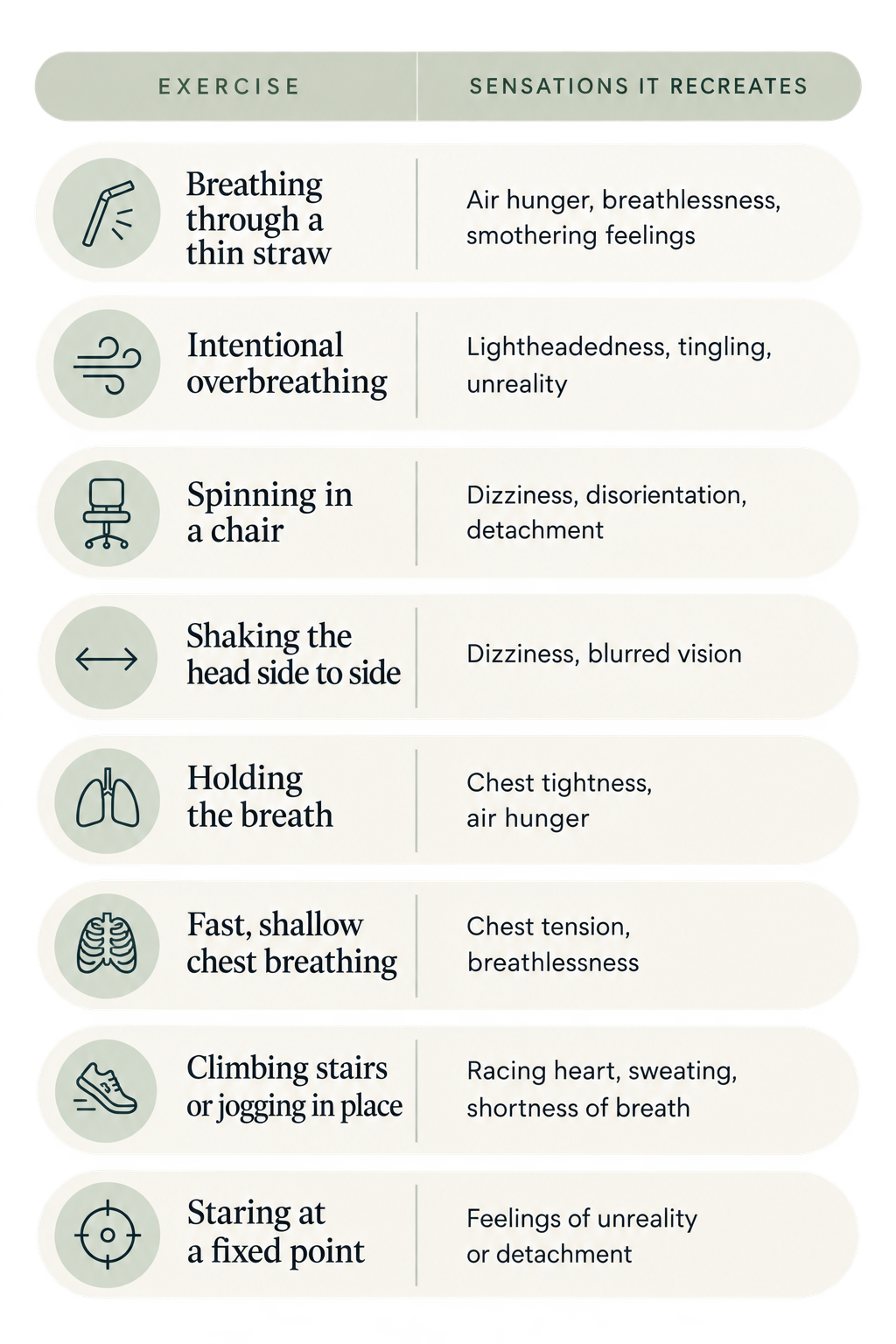
These exercises start in a therapist's office. Several may be inappropriate for people with certain heart, lung, or neurological conditions, and during pregnancy, so medical screening comes first. Once screening is complete and the exercises are familiar, home practice becomes part of treatment.
What to Expect in a Session
Interoceptive exposure follows a clear structure. Each step is explained before it happens, and the pace is set collaboratively.
Ruling Out Medical Causes
Symptoms such as chest pain, breathlessness, and dizziness need medical evaluation before exposure work begins. This protects your health and supports the therapy itself.
Identifying Your Feared Sensations
The therapist guides you through brief versions of several exercises to determine which sensations most closely match your panic and which provoke the most fear. These are ranked from least to most distressing, creating a clear plan for the sessions ahead.
Repeated Practice Until Fear Decreases
Treatment begins with a moderately challenging exercise. You bring on the sensation, stay with it, and allow it to pass. Then you repeat it. Across repetitions, the sensation stays the same while the fear attached to it may decrease. This pattern is one of the most consistent findings in exposure research.
Reducing Safety Behaviors
The therapist helps you identify subtle safety behaviors, such as sitting down, gripping a chair, or monitoring your pulse, and practice releasing them during exercises. This step ensures the learning is complete: safety came from the situation itself, not from a protective ritual.
Practice Between Sessions
Once exercises feel manageable in session, agreed-upon versions are practiced at home. Later, practice extends into daily life, and may include activities such as hot showers and physical activity. This stage ofexposure therapy consolidates progress so it holds outside the therapy office.
Interoceptive Exposure vs. In Vivo Exposure
In vivo exposure addresses feared external situations, such as driving on the freeway, riding an elevator, or sitting in a crowded theater. Interoceptive exposure addresses feared internal sensations, such as a racing heart or dizziness.
In panic disorder, the two are connected. The freeway is usually avoided because of the sensations a person expects to feel there, with no quick exit available. For this reason, panic treatment often begins with interoceptive work and then adds in vivo exposure.
Is Interoceptive Exposure Part of CBT?
Yes. Interoceptive exposure is a core component of cognitive behavioral therapy (CBT) for panic disorder. It was built into panic-focused CBT protocols developed in the late 1980s, most notably David Barlow's Panic Control Treatment, and remains standard in evidence-based panic treatment today.
What the Research Says
Interoceptive exposure appears to be one of the most important ingredients in panic treatment.
Research comparing the individual components of CBT for panic disorder points to interoceptive exposure as one of the strongest. A review of 72 studies found that treatment including interoceptive exposure, delivered face to face with a trained professional, was linked to better outcomes and higher acceptability among clients. For anyone seeking panic treatment, it is reasonable to ask a prospective therapist whether interoceptive exposure will be part of the plan.
When Interoceptive Exposure Isn't the Right Fit
Certain conditions require modifications to interoceptive exposure. Heart conditions, respiratory illness, seizure disorders, and pregnancy can make specific exercises unsafe, which is why medical clearance always comes first. In these situations, the therapist adjusts or substitutes exercises accordingly.
Timing also matters. For some people, panic is closely tied to unprocessed traumatic experiences. In these cases, trauma-focused treatment such asEMDR therapy may come first or run alongside exposure work, so the nervous system is stable enough for exposure to be effective.
An experienced therapist assesses these factors at the start and sequences treatment based on each person's history, health, and goals.
Therapy for Panic in San Jose
Panic disorder is a treatable anxiety condition, and structured treatment produces meaningful improvement for most people who complete it.
As a licensed therapist specializing in anxiety, trauma, and panic. I provide exposure therapy and EMDR in my West San Jose office and virtually throughout California, with over seven years of experience in evidence-based care.
To find out whether this approach fits your situation, you canbook a free 15-minute consultation call. The call is a chance to describe what has been happening, ask questions, and decide on next steps.
Frequently Asked Questions
Is interoception linked to anxiety?
Yes. Interoception is the brain's ability to sense internal bodily signals. People with panic tend to monitor these signals closely and interpret them as dangerous. Treatment focuses on changing that interpretation.
What is the difference between EMDR and exposure therapy?
Exposure therapy involves deliberately and repeatedly facing feared sensations or situations until the fear decreases. EMDR helps the brain reprocess distressing memories using bilateral stimulation, such as guided eye movements. Both are evidence-based, and they are sometimes combined when panic has roots in past trauma.
Can I do interoceptive exposure on my own?
It is best practice to start with a therapist. A trained therapist will provide structure to help ensure the exposures are at a sufficient duration and repetition, as well as help detect any subtle avoidance or safety behaviors, so exposures don’t inadvertently reinforce the fear. After the approach is practiced in session, home practice becomes a standard part of treatment.
How long does it take to work?
Panic-focused CBT that includes interoceptive exposure typically runs 10 to 16 sessions, depending on each person's history and goals. Many people notice their fear of specific sensations easing within the first few weeks of practice.
Does panic feel worse before it gets better?
Sessions involve deliberate, short-lived discomfort, because that is where the learning happens. This can be uncomfortable. Leaning into the discomfort is part of treatment, especially in the beginning. Most people find the exercises are still manageable, since they are gradual, predictable, time-limited, and chosen. As treatment progress is made, anxiety goes down and tolerance for the uncomfortable physical sensations goes up.
